
To rank higher on Google Maps, make your Google Business Profile the most relevant match for the search, show more and fresher proof that customers choose you, and make sure Google can confirm your details everywhere it looks. You cannot change how far you are from the searcher, so the work goes into everything else.
What decides the Google map pack
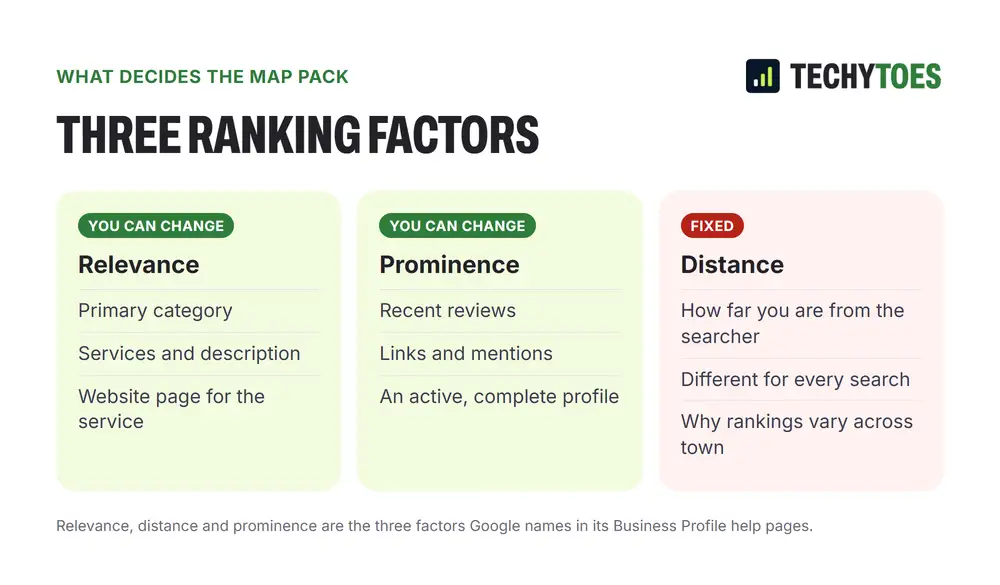
The Google map pack, also called the local pack, is the block of three businesses with a map that appears for local searches. Google ranks it on three things:
- Relevance: how well your profile matches the search. Your primary category, services, description and website content decide this.
- Distance: how far your business is from the person searching. You cannot change it.
- Prominence: how well known and trusted you look: reviews, links, mentions and how complete your listing is.
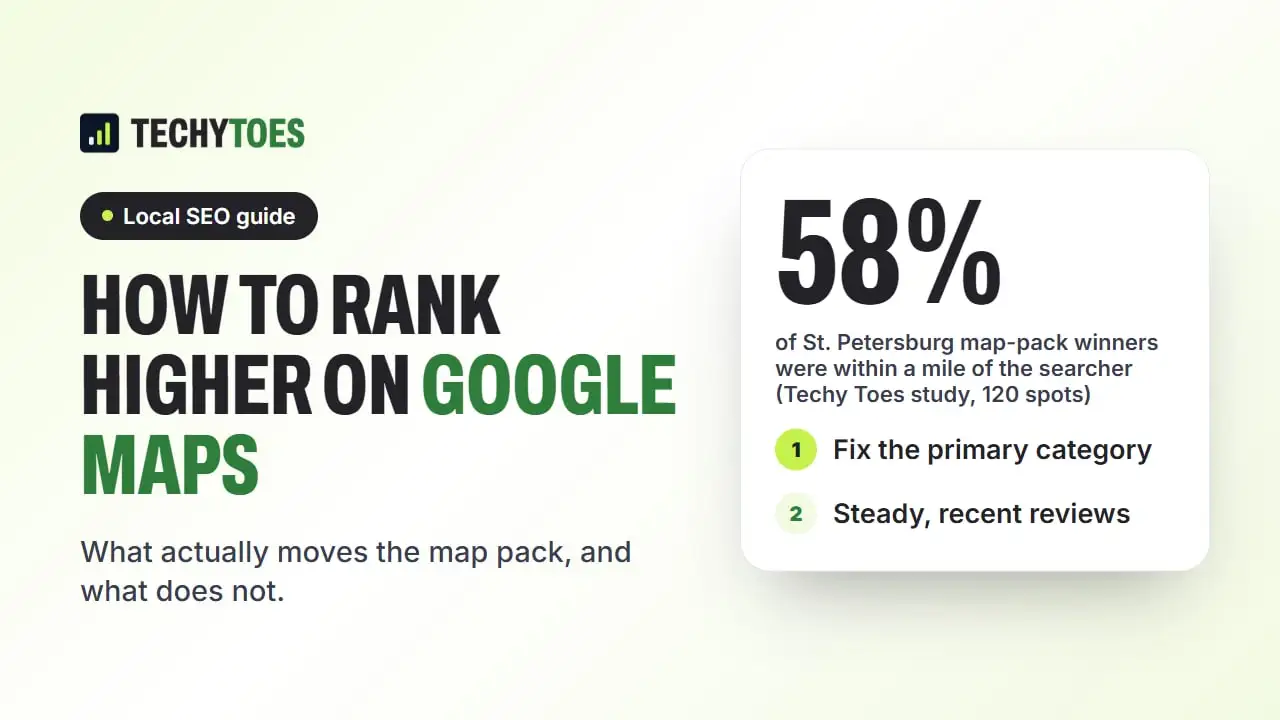
Distance does more work than most owners expect. In our study of 120 top-3 map spots in St. Petersburg, 58% of winners were within a mile of the searcher, 83% within two miles, and none more than three. That is why a business can rank first outside its door and not at all across town.
How to rank on Google Maps: the changes that move you up
These are the changes that most often move a listing up, in order.
- Fix the primary category. Match it to the listings already ranking for your most valuable search. This is the biggest single lever.
- Complete the profile. Every service listed and described, correct hours, attributes and service areas.
- Remove duplicates. Two listings for one business split your reviews and history.
- Build a steady flow of reviews. Recent reviews matter more than a big total from years ago.
- Post weekly and add real photos, so the listing looks active.
- Strengthen the website page your profile links to. Make it about your main service and location, with the same name, address and phone.
- Earn local mentions and links from news sites, business groups and partners in your area.
Our step-by-step Google Business Profile optimization guide covers each of these in detail.
How many reviews do you need to rank on Google Maps?
There is no universal number. In our St. Petersburg study the median top-3 listing had 180 reviews, but 26% of top-3 spots went to listings with fewer than 50, almost always close to the searcher. Review needs vary hugely by category: the median top-3 AC repair listing had 35 reviews, while auto repair had 706.
Benchmark the three listings your customers actually see from where they search, and aim to keep a steady pace of new reviews rather than chase a city-wide figure.
Google maps ranking check: measure from many points, not one
A single search from your office tells you almost nothing, because rankings change street by street. A proper Google Maps ranking check uses a grid: the same search run from dozens of points across your area, showing where you rank at each one.
[ADD: anonymised before/after geo-grid screenshots from a client profile, with the search term, grid size and dates labelled]
Run the grid before you change anything, then monthly. The goal is not one green square but more of the area covered. Our guide to local rank tracking explains how to read a grid report.
Why the website still matters for local ranking
Your profile wins searches near your address. To reach customers further out, you need pages on your website for the services and areas you want, because those rank in the ordinary results below the map, where distance matters much less. The two work together: a strong website also makes the profile it links to more relevant.
What does not help
- Keywords in your business name. It breaks Google’s rules and can get the profile suspended.
- Fake addresses or virtual offices. Same risk, and suspension can take your reviews with it.
- Geotagged photos. Published tests found no ranking effect.
- Buying hundreds of directory listings. The main directories matter; the rest do little.
Key takeaways
- The map ranks on relevance, distance and prominence. Work on the two you can change.
- Start with the primary category, then complete the profile and remove duplicates.
- Keep reviews coming steadily. Recency beats a big old total.
- Measure with a grid, not a single search.
- Use your website to reach the areas your profile cannot.
When you want the profile handled and tracked for you, see our GBP optimization services.
Frequently asked questions
How long does it take to rank higher on Google Maps?
Category and profile fixes can show within a few weeks, because Google re-reads a profile quickly. Gains from reviews, links and website pages build over two to three months or more. Measure across a grid of your area each month so you can see coverage spreading, not just one position changing.
Why do I rank on Google Maps in one place but not another?
Because distance from the person searching is part of the ranking. A listing usually ranks best near its own address and fades with distance. In our St. Petersburg study, 58% of top-3 listings were within a mile of the searcher and none were more than three miles away.
Does paying for Google Ads improve my Google Maps ranking?
No. Ads can appear above or inside the map results, but they are separate from the organic map ranking and do not change it. When you stop paying, the ads disappear and your organic position is where it was.
What is the difference between the map pack and the local pack?
They are the same thing: the block of three businesses with a map that Google shows for local searches. "Local Finder" is the longer list you see when you click through to more results.