
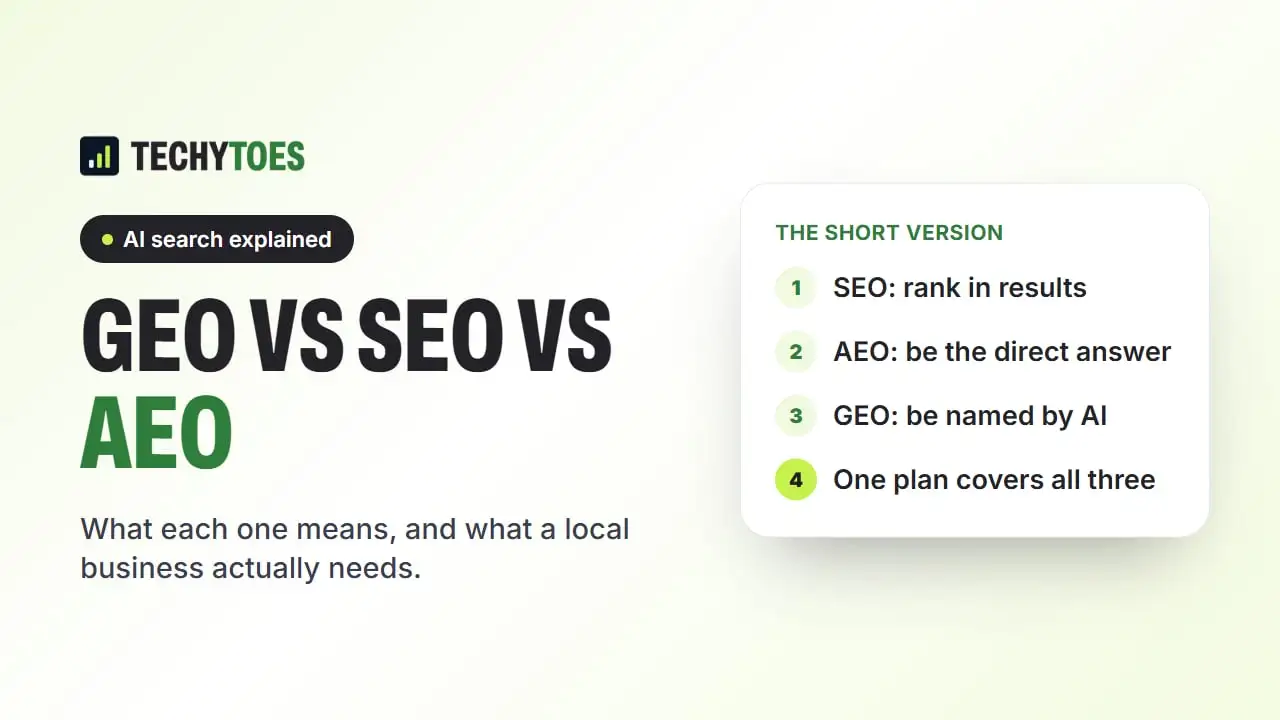
SEO gets your pages found and ranked in search results. AEO (answer engine optimization) makes your content the direct answer in snippets and voice results. GEO (generative engine optimization) gets your business cited or recommended inside AI-written answers. For a local business they share the same foundations, and one plan covers all three: a site search engines and AI tools can read, pages that answer questions plainly, consistent business details, and strong listings and reviews.
GEO vs SEO: what is actually different
A traditional search engine ranks a list of pages and lets the searcher choose. A generative AI tool reads several sources, writes one answer, and names or cites only a few. So the unit of competition changes: you are no longer competing as a page in a list, but as a passage worth quoting or a business worth naming.
That has a surprising side effect. A clear, specific paragraph on a small local site can be quoted over a vague one on a much larger site, because the AI tool is looking for something it can lift and stand behind.
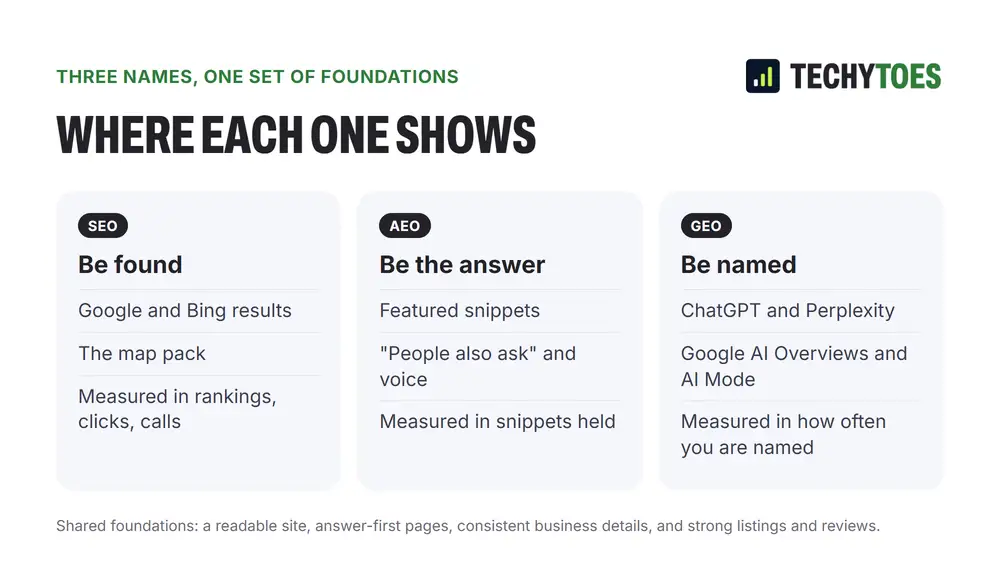
| SEO | AEO | GEO | |
|---|---|---|---|
| Goal | Rank pages in search results | Be the direct answer | Be cited or named in AI answers |
| Where it shows | Google and Bing results, map pack | Featured snippets, “People also ask”, voice | ChatGPT, Perplexity, Google AI Overviews and AI Mode |
| What wins | Relevance, authority, technical health | A clear answer near the top of the page | Clear, specific passages and consistent facts across the web |
| How you measure it | Rankings, clicks, calls | Snippets held | How often you are named for a fixed set of questions |
AEO vs SEO: being the answer, not just a result
Answer engine optimization is SEO with one rule moved to the front: answer the question in the first sentence under the heading. Featured snippets, “People also ask” boxes and voice assistants take short, direct answers. A page that opens with three sentences of background before reaching the point rarely gets chosen.
Generative engine optimization: what it adds
Generative engine optimization adds three things to good SEO:
- Passages that stand on their own. Each answer makes sense if it is lifted out of the page, with the answer first and the detail second.
- Specifics worth quoting. Prices, services, areas, hours and real results, written as text and dated where they can change. A vague claim gives an AI tool nothing to cite.
- One consistent picture of your business. The same name, address, services and description on your site, your schema, your Google profile and your listings. When sources disagree, AI tools hesitate to name you.
Answer engine optimization and GEO for a local business
For local recommendations, the sources AI tools read go beyond your website. Google’s AI features draw on its own index and Business Profile data. Yelp says its ratings and reviews now power ChatGPT’s local experience. So the local version of GEO is mostly:
- a complete, active Google Business Profile with steady reviews;
- accurate listings on Yelp, Apple Maps and Bing Places;
- a website with a clear page for each service and area;
- the same details everywhere.
What our Tampa Bay study found
On 23 October 2026 we ran 60 Google searches across Tampa Bay. AI Overviews appeared on 45% of them, on every “how much does it cost” question, and on only 17% of “near me” searches, while the map pack appeared on 48 of the 60. AI answers dominate research and price questions; the map still decides many searches from people ready to hire. Read the full Tampa Bay AI search study.
How to measure GEO honestly
There is no Search Console for ChatGPT, and anyone selling you a “rank” in an AI tool is describing something that doesn’t exist. What you can measure:
- A fixed set of questions your customers ask, run monthly across the main AI tools, recording who is named.
- AI Overview appearances for your tracked searches.
- Referral traffic from AI tools that pass it.
- Branded searches, which tend to rise when a business starts being named.
Where a local business should start
- Fix the basics of your Google Business Profile and listings.
- Rewrite your main service pages so each question is answered in the first sentence.
- Put key facts in text, not images.
- Make your business details identical everywhere.
- Add structured data that matches the page.
- Check monthly which businesses AI tools name for your customers’ questions.
Key takeaways
- SEO, AEO and GEO share the same foundations.
- GEO’s unit is the passage and the business name, not the page position.
- Locally, listings and reviews feed AI answers.
- Measure presence over a fixed set of questions, not a rank.
For the work done for you, see our AI SEO agency service.
Frequently asked questions
Is GEO replacing SEO?
No. GEO builds on SEO. AI tools still need to find and read your pages, which is exactly what SEO makes possible, and for many local searches Google still shows the map pack and links. In our study of 60 Tampa Bay searches, the map pack appeared on 48 of them.
What is the difference between AEO and GEO?
AEO (answer engine optimization) is about being the direct answer: featured snippets, voice answers and "People also ask". GEO (generative engine optimization) is about being cited or named in AI-written answers from tools like ChatGPT, Perplexity and Google's AI Overviews. The work overlaps heavily.
Does a small local business need GEO?
It needs the parts that matter locally: clear pages that answer customers' questions, consistent business details everywhere, and complete listings and reviews on the sites AI tools read. Those also help regular SEO, so the effort is not wasted if AI search changes again.