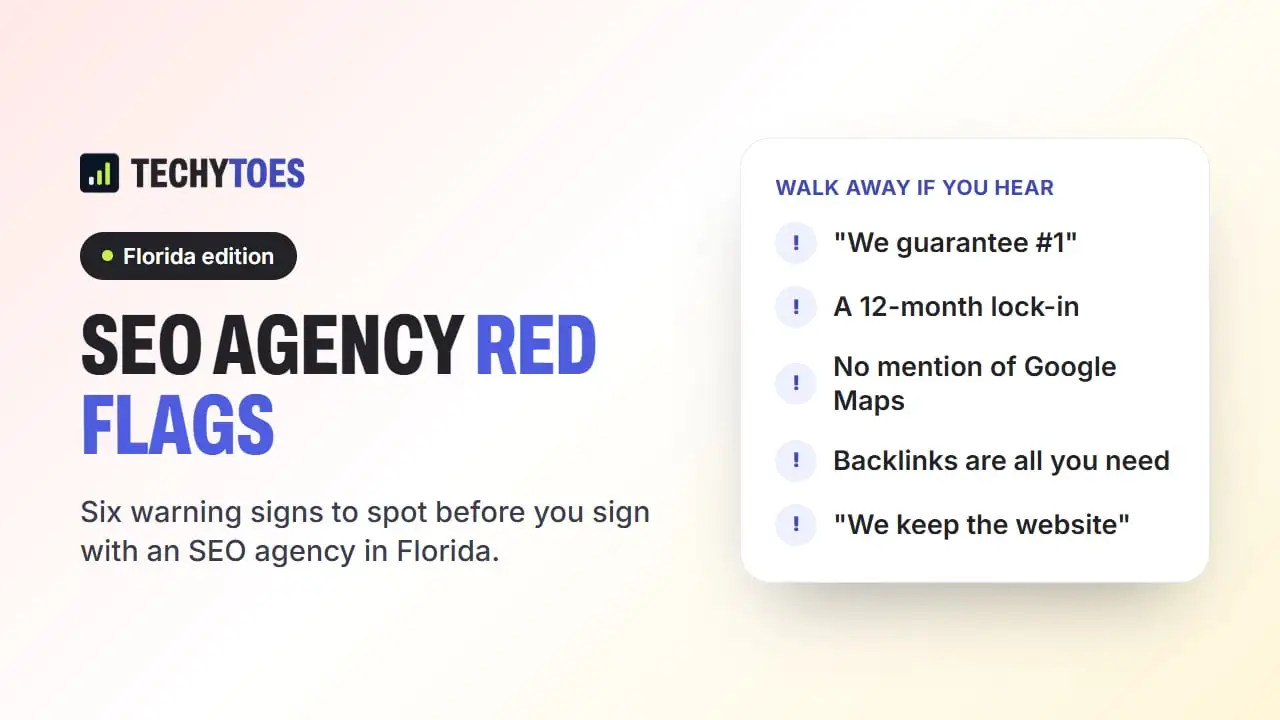
Most SEO agencies in Florida are trying to do good work. Some aren’t, and a few habits make them easy to spot. Here are six red flags to watch for before you sign, with what a reasonable agency does instead. If you hear more than one of these in a sales call, keep looking.
Learning objectives
By the end of this guide you’ll be able to:
- Spot the six most common SEO agency red flags.
- Tell a reasonable contract from a lock-in.
- Check whether a proposal covers the work that brings local calls.
- Protect your website, accounts and content before you sign anything.
1. “Guaranteed #1” or “we’ll rank you #1”
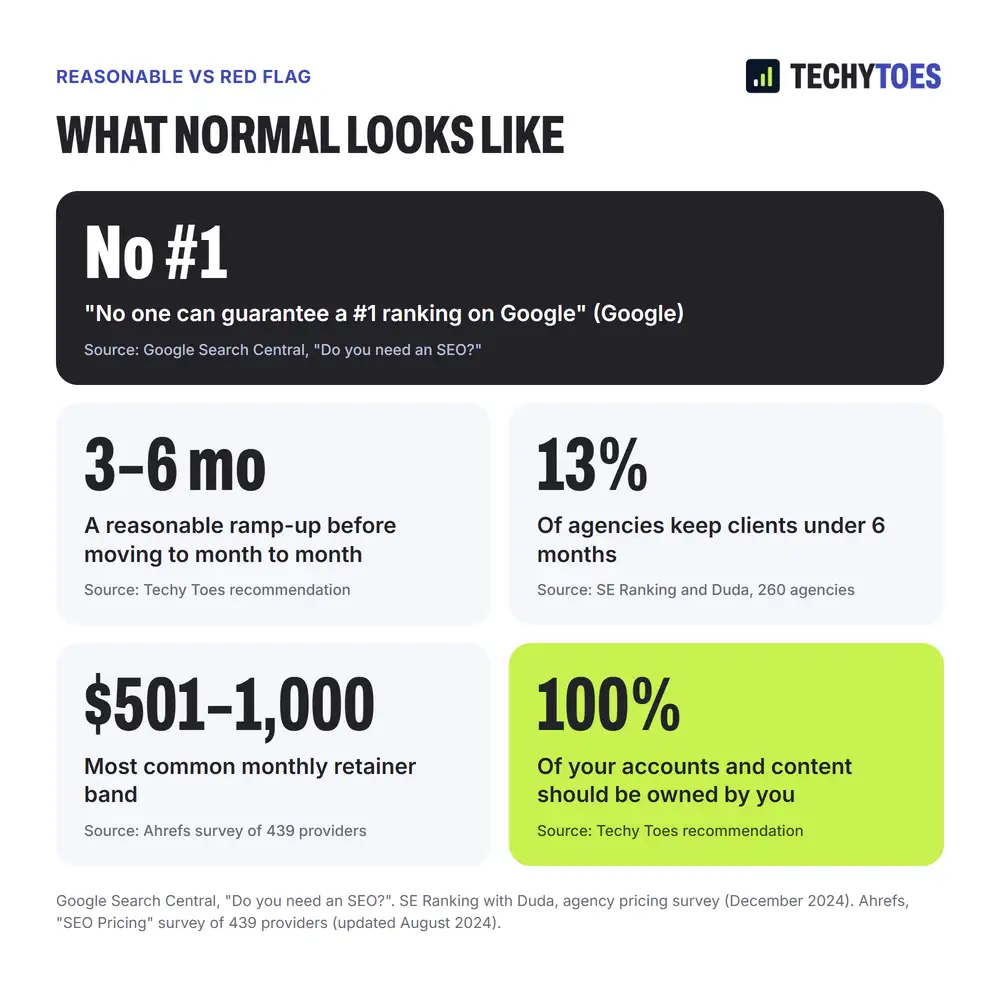
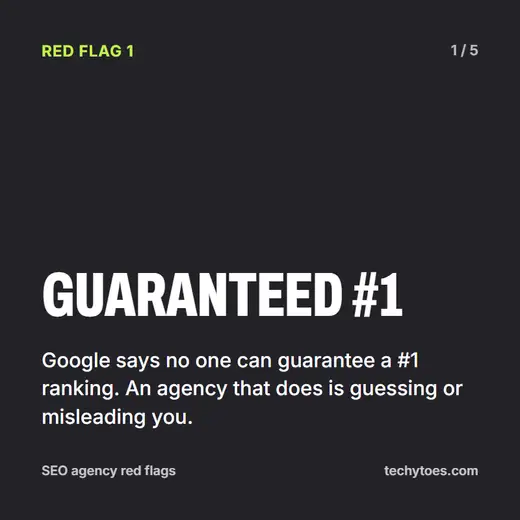
Google’s guidance on hiring an SEO says it directly: no one can guarantee a #1 ranking on Google. Rankings depend on Google’s systems, your competitors and, for local searches, where the person searching is standing. In our St. Petersburg map pack study, the same search produced different top-three businesses in each part of the city. A “guaranteed #1” usually means a ranking for an obscure phrase nobody searches, or a promise the agency can’t keep.
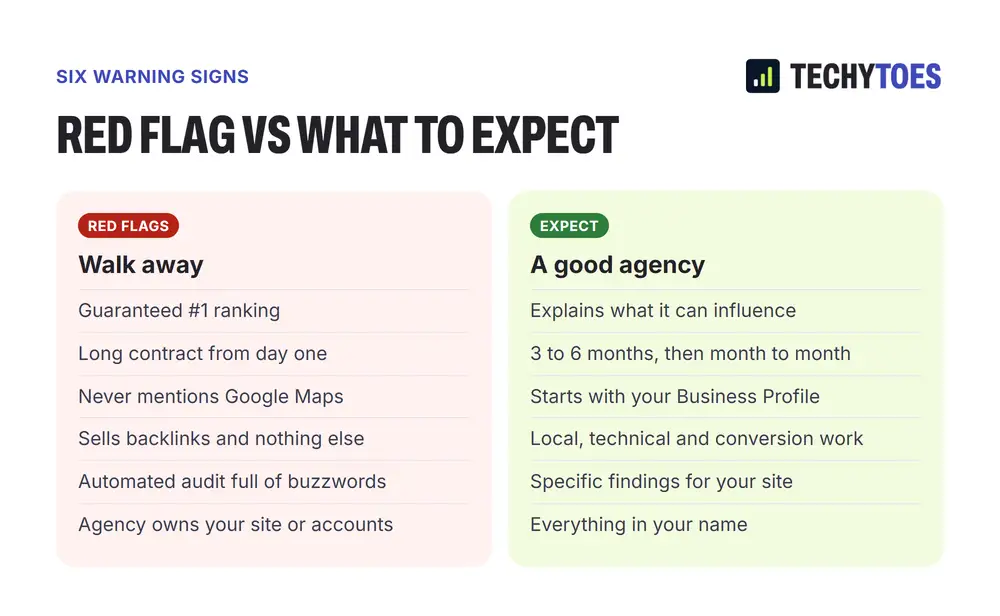
What to expect instead: a clear explanation of what the agency can influence and how it will measure progress.
2. Long contracts with no way out
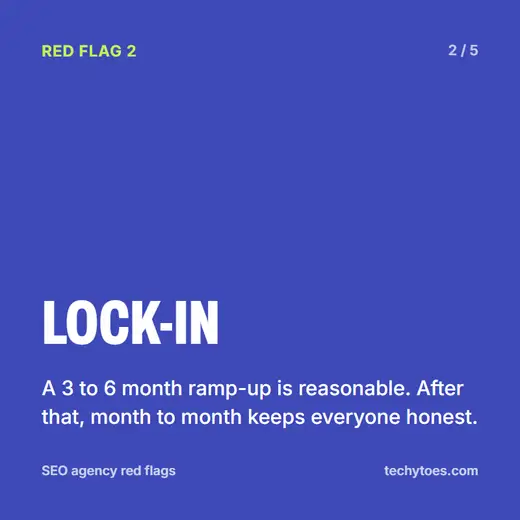
SEO takes months, so some commitment is fair. A three to six month ramp-up gives an agency time to set things up and show early movement. After that, month to month is reasonable. Twelve-month contracts with early-exit fees mainly protect the agency. In a December 2024 survey of 260 agencies by SE Ranking and Duda, only 13% said they keep clients for less than six months, so a good agency doesn’t need to lock you in to keep you.
What to expect instead: three to six months, then month to month, with a short notice period.
3. Never mentioning Google Business Profile or Maps
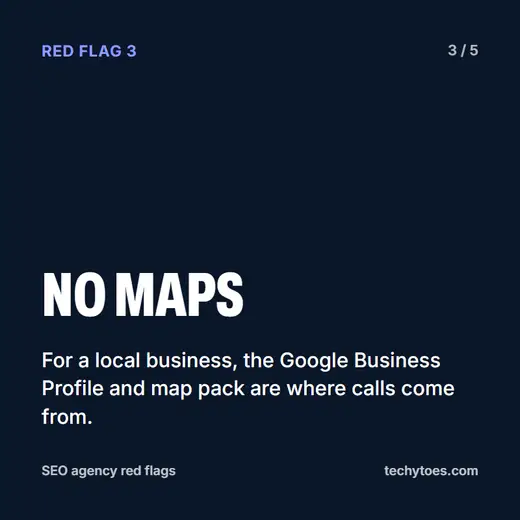
For a local business, the Google Business Profile and the map pack at the top of the results are often where most calls come from. An agency that talks only about keywords and blog posts, and never mentions your profile, your reviews or Google Maps, isn’t doing local SEO. Our Google Business Profile checklist shows what that work involves.
What to expect instead: your Business Profile reviewed in the first conversation.
4. Selling backlinks alone
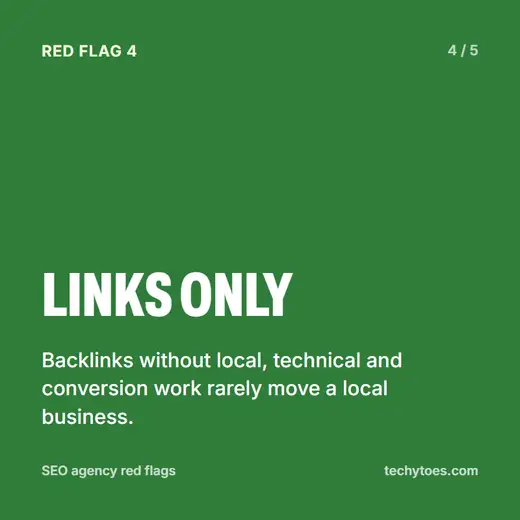
Links matter, but a plan that’s only “we’ll build you X links a month” leaves out most of what moves a local business. Local SEO also needs your profile, citations, reviews, a technically sound website and pages that turn visitors into calls. Bulk link packages also tend to come from low-quality sites that can do more harm than good.
What to expect instead: local, technical and conversion work, with links earned from relevant local sources.
5. Cookie-cutter automated audits
A free “SEO audit” with a score out of 100, red warnings and a page of buzzwords is usually generated by software in seconds. It might list hundreds of “errors” that make no difference, and miss the things that do. A real audit is specific to your site: which pages to fix, which searches you’re missing, and what your competitors are doing that you aren’t.
What to expect instead: findings you could act on, written about your business.
6. The agency keeps ownership of your assets
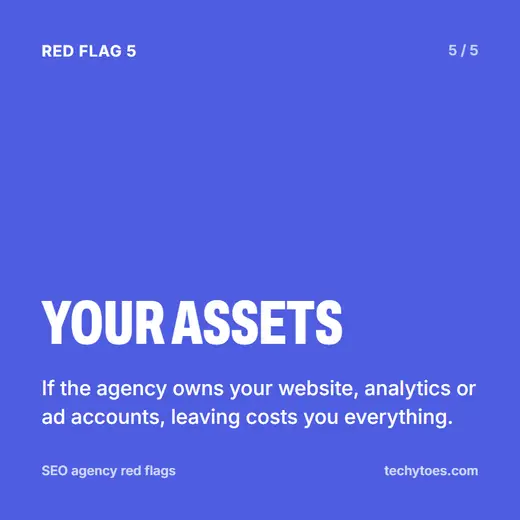
Some agencies build your website on their own hosting, create your Google Business Profile or ad accounts under their own logins, or keep the content they wrote. When you leave, you can lose your site, your reviews history or years of ad data. This one causes the most damage, because you often don’t find out until it’s too late.
What to expect instead: your website, domain, Business Profile, analytics, Search Console and ad accounts all in your name, with the agency added as a user.
SEO agency red flags: five cards
Key takeaways
- No one can guarantee #1. Google says so itself.
- Three to six months, then month to month. Anything longer needs a good reason.
- Local SEO starts with your Business Profile. If it’s never mentioned, it’s not local SEO.
- Links alone aren’t a plan. Local, technical and conversion work matter as much.
- Own everything. Your site, accounts and content must be in your name.
Quiz: test what you learned
Five questions on this guide. Tap a question to see the answer.
1. What does Google's own guidance say about guaranteed #1 rankings?
That no one can guarantee a #1 ranking on Google.
2. What's a reasonable contract structure for SEO?
A three to six month ramp-up, then month to month with a short notice period.
3. Why is an agency that never mentions Google Maps a red flag for a local business?
Because the Business Profile and the map pack are often where most local calls come from.
4. How can you tell an automated audit from a real one?
A real audit is specific to your site and your competitors. An automated one gives a generic score, long lists of minor "errors" and buzzwords.
5. Which accounts should always be in your name?
Your website and domain, Google Business Profile, analytics, Search Console and ad accounts.
Related reading
For the questions to ask before you sign, read what to ask your Tampa Bay SEO agency. For prices, see how much SEO costs in Tampa. And to see how we handle contracts and ownership, visit our local SEO services page or our St. Petersburg FL SEO page.