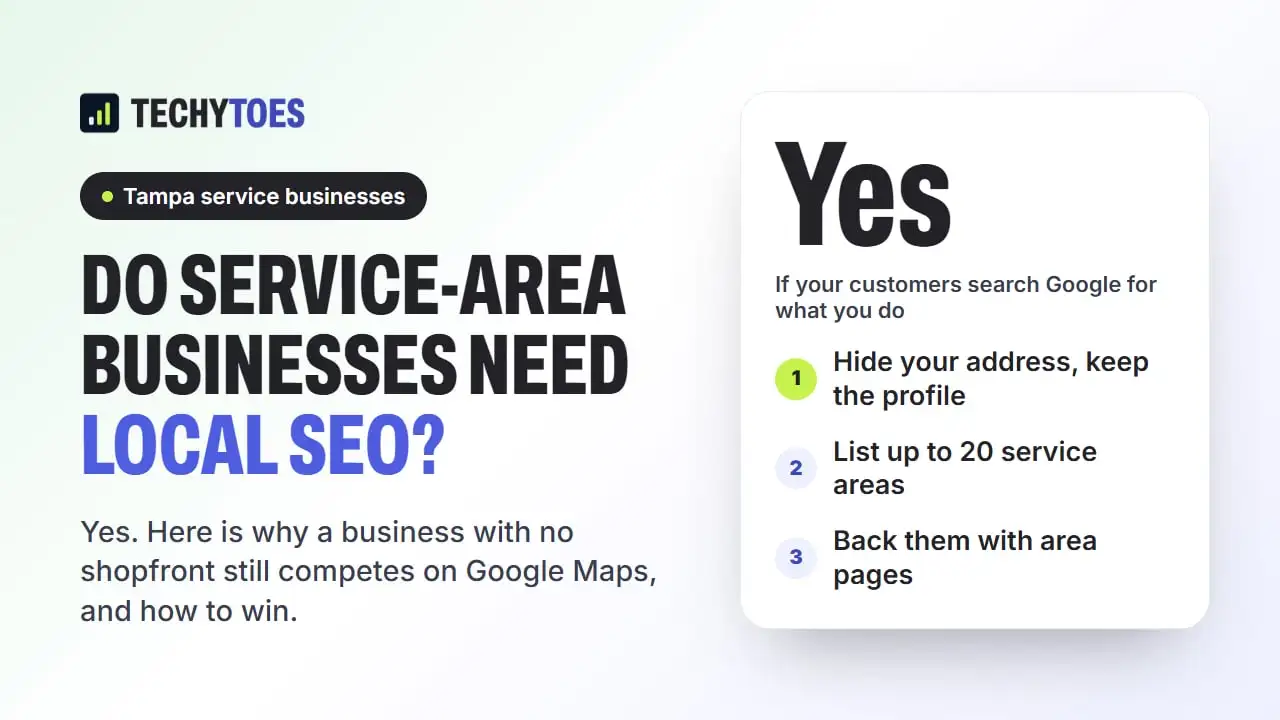
Yes. If customers find businesses like yours by searching Google, you need local SEO, whether or not you have a shopfront. Plumbers, roofers, cleaners, pest control companies and mobile detailers all compete on the same Google Map as businesses with a front door. The difference is how you set things up. This guide covers how Google treats a service-area business, what the limits are, and how to reach customers across Tampa rather than just near your base.
Learning objectives
By the end of this guide you’ll know:
- What counts as a service-area business on Google.
- How to set up a Business Profile with a hidden address and service areas.
- Why distance still matters even when you travel to customers.
- How to reach customers in the parts of Tampa further from your base.
What a service-area business is
A service-area business goes to its customers instead of having them visit. Google treats it slightly differently: you can hide your street address on your Business Profile and show the areas you serve instead. You still need a real location to verify the profile, such as your office or home base. A PO box or a virtual office doesn’t count.
Setting up your Business Profile
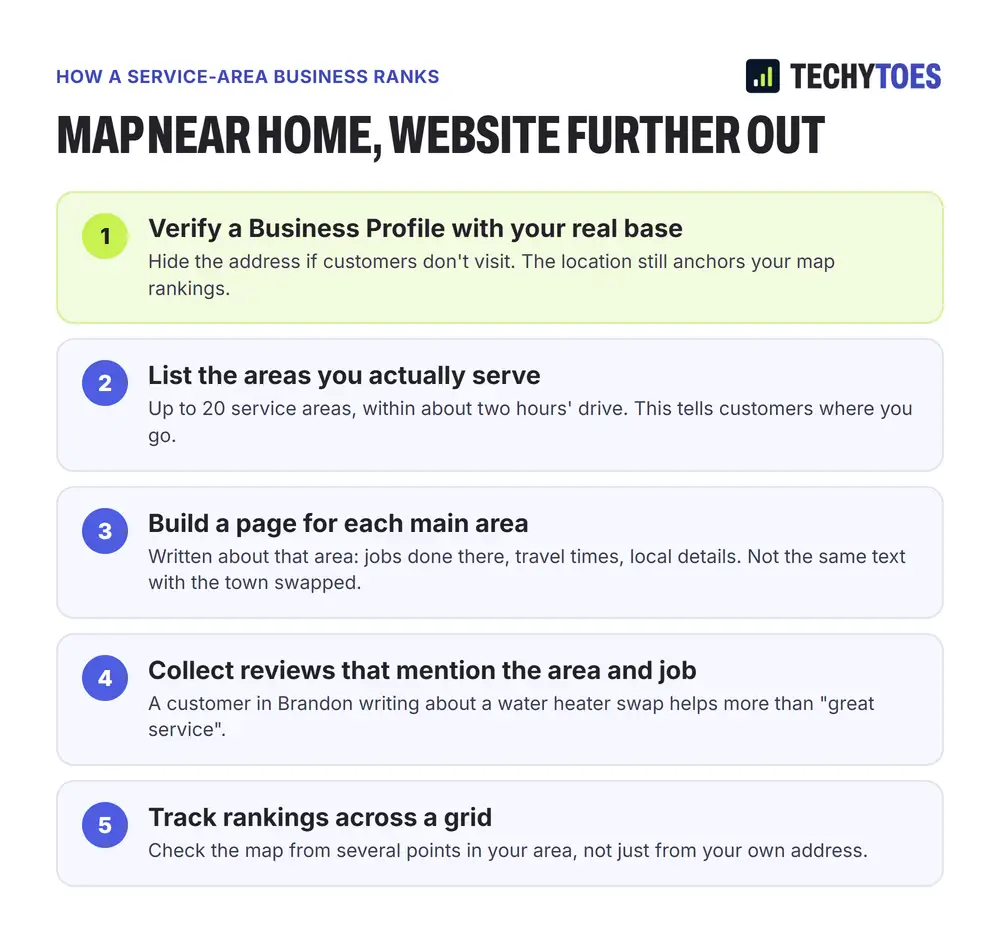
- Verify with your real base, then hide the address if customers don’t come to you.
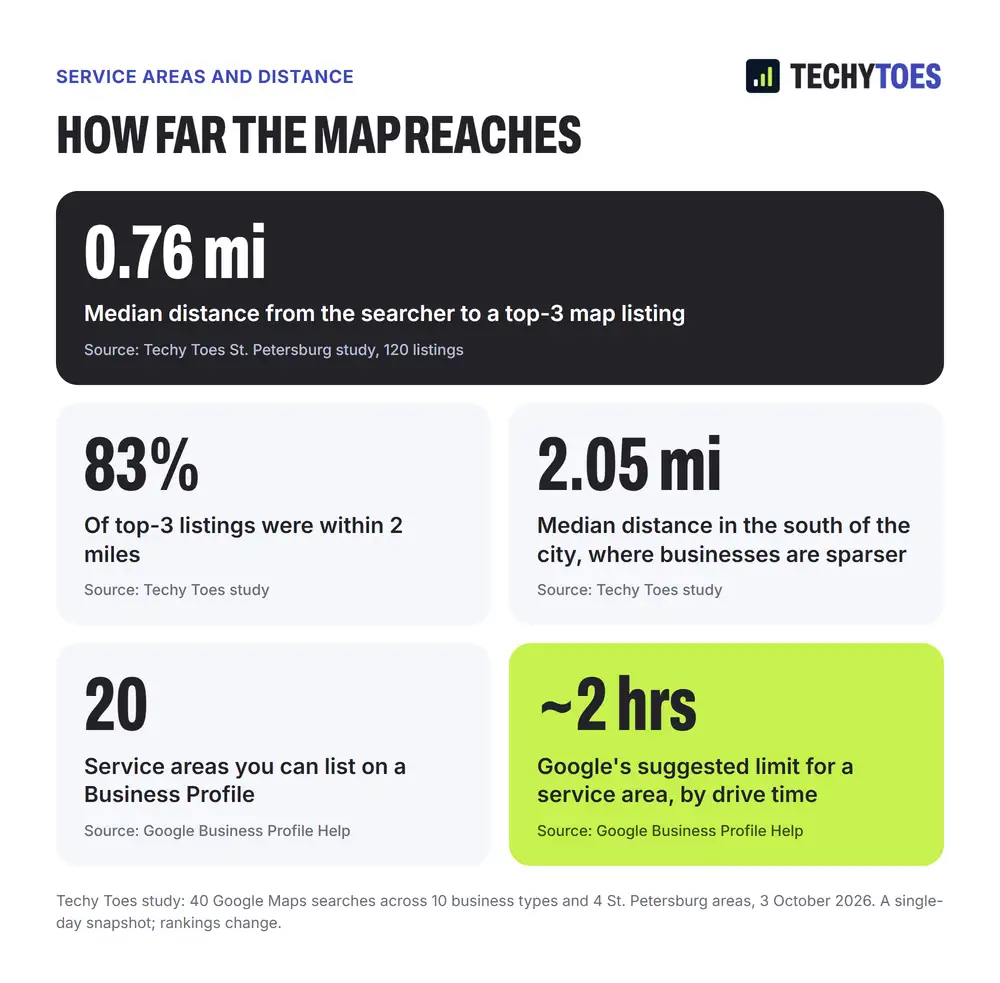
- List your service areas. Google allows up to 20, set by city or postal code, and recommends staying within about two hours’ drive.
- Pick the most specific primary category for your main service.
- Add every service you offer, with a short description of each.
- Add real photos of your work, your vans and your team.
Our Google Business Profile checklist covers every field.
Distance still matters
Service areas tell customers where you go. They don’t move the point Google measures you from. Map rankings still depend heavily on how close your verified location is to the person searching. In our study of 120 Google Maps top-3 spots in St. Petersburg, the median top-3 listing was 0.76 miles from the searcher, and 83% were within two miles. Where businesses were more spread out, in the south of the city, the median rose to 2.05 miles.
So a pest control company based in Carrollwood will usually rank well on the map in Carrollwood and the nearby neighbourhoods, and less well in Riverview or South Tampa, whatever its service areas say.
Reaching customers further out
Your website does the work the map can’t. Build a page for each main area you serve, written about that place: the jobs you’ve done there, how quickly you can get there, and anything specific to the area, such as older homes, flood zones or HOA rules. Don’t copy the same page and swap the town name. Google sees through it, and it doesn’t help customers.
Reviews help too. A review from a customer in Brandon that mentions a water heater replacement tells Google, and the next customer, that you work there and what you do. Ask customers to mention the job and the area if they’re happy to.
Finally, track your rankings across a grid of points in your service area, not just from your own address. It shows you where you’re strong and where you need more work. Our Tampa SEO services include grid tracking as standard.
Service-area business SEO: five cards
Key takeaways
- Yes, you need local SEO. You compete on the same map as shopfront businesses.
- Hide the address, keep the profile. But verify it with a real location.
- Service areas don’t move your ranking point. Distance still counts.
- Area pages reach further. Write each one about the place itself.
- Track a grid, not just your own address.
Quiz: test what you learned
Five questions on this guide. Tap a question to see the answer.
1. Can a service-area business hide its address on Google?
Yes, if customers don't visit. It still needs a real location to verify the profile.
2. How many service areas can you list, and how far should they reach?
Up to 20, within about two hours' drive of your base.
3. In our St. Petersburg study, what was the median distance from the searcher to a top-3 map listing?
0.76 miles.
4. What reaches customers in areas where the map doesn't show you?
A page on your website for each main area, written about that place, plus reviews from customers there.
5. Why track rankings across a grid?
Because you rank differently in each part of your area, and one check from your own address hides that.
Next steps
See how we work for service businesses on our Tampa SEO services page, read local SEO for home service contractors, or explore our local SEO services.