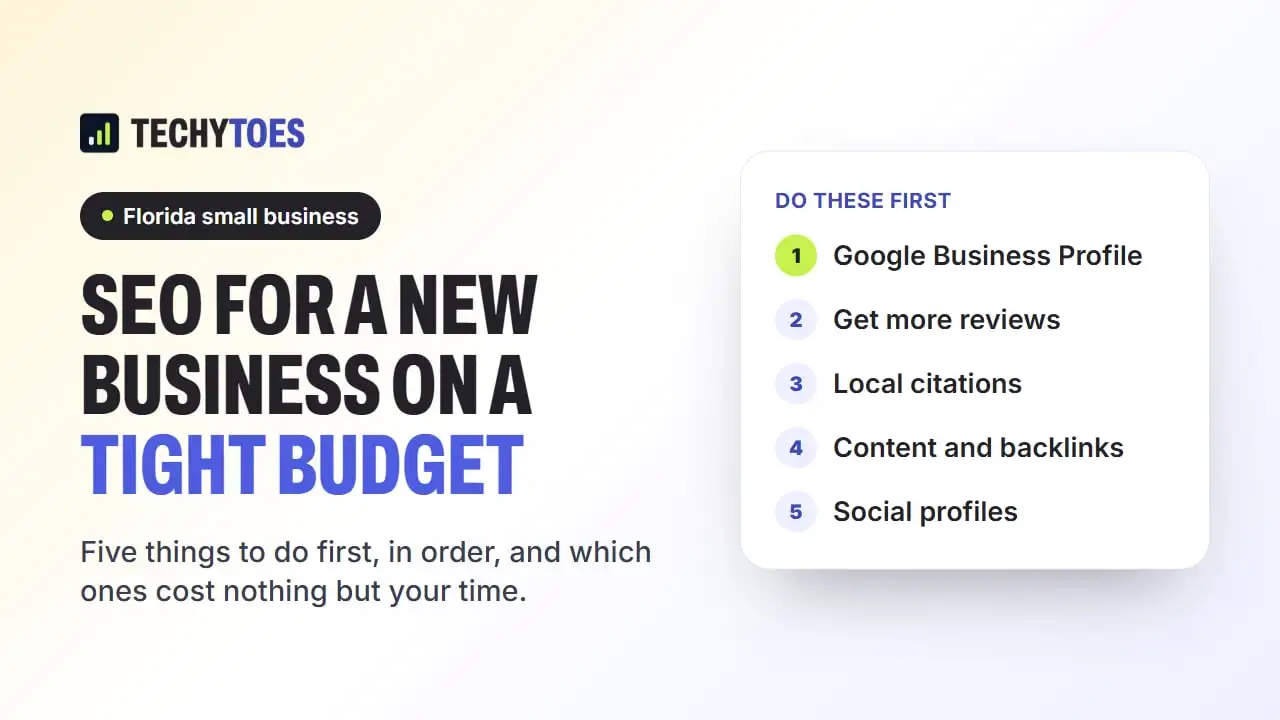
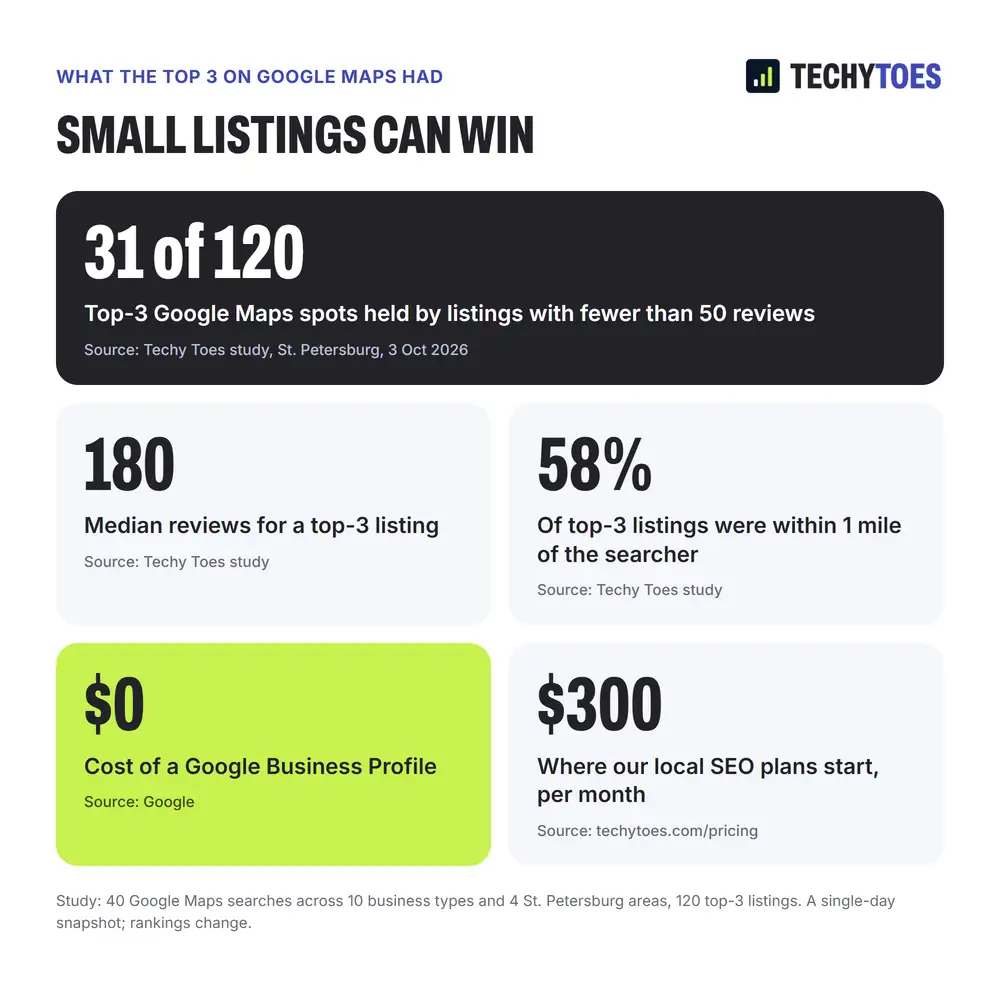
A new local business with very little money can still show up on Google. The order you do things in matters more than the budget. Most of the first steps cost nothing but your time, and they’re the same steps an agency would start with. In our study of 120 Google Maps top-3 spots in St. Petersburg, 31 of them went to listings with fewer than 50 reviews, so a new business isn’t shut out. Here are the five steps, cheapest first.
Learning objectives
By the end of this guide you’ll know how to:
- Set up a Google Business Profile that’s ready to rank.
- Get reviews steadily without paying for them.
- List your business in the directories that count, and keep the details consistent.
- Start building content and local links on a small budget.
- Set up social profiles that support your SEO instead of distracting from it.
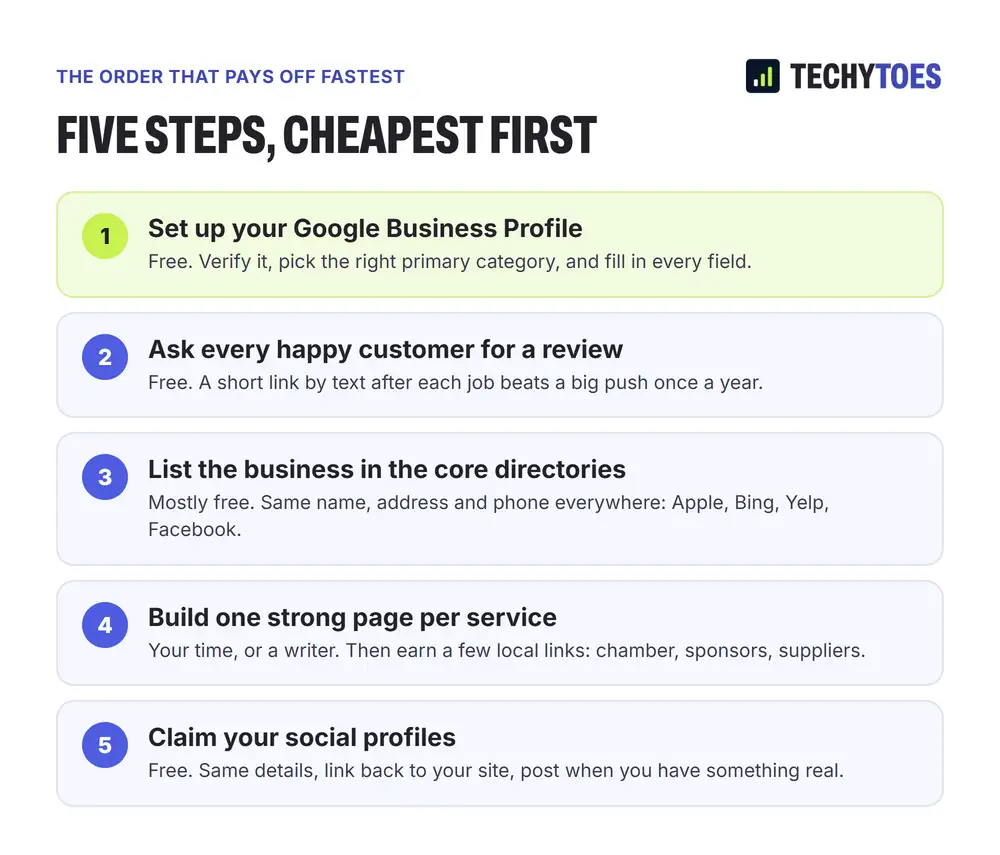
1. Set up your Google Business Profile
This is the single most valuable free step for a local business. Your profile is what appears on Google Maps and in the local results at the top of Search, and for many small businesses it brings more calls than the website.
- Verify it. Google will ask you to confirm the business, usually by video or postcard. Nothing ranks until it’s verified.
- Choose the right primary category. Pick the one that best describes your main service. “Plumber” beats “Contractor” if plumbing is what you do. Add secondary categories only for things you genuinely offer.
- Fill in everything. Hours, phone, website, services, a plain description of what you do, and real photos of your work, your team and your premises.
- Set your service area if you travel to customers. Google lets you list up to 20 areas, and recommends keeping them within about two hours’ drive of your base.
Our Google Business Profile checklist goes through every field.
2. Get more reviews
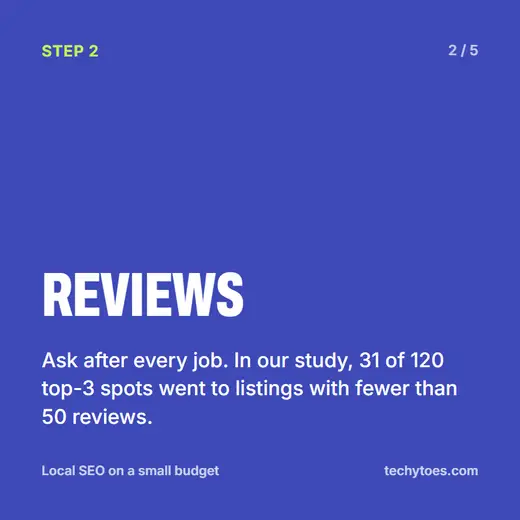
Reviews help you rank, and they help customers choose you once they see you. You don’t need hundreds. You need a steady flow.
- Ask every happy customer, ideally the same day, by text with a direct link to your review form.
- Make it easy. One link, one tap. Put it on your invoice and your email signature too.
- Reply to every review, good or bad. It shows you’re active and gives you a chance to mention the service you provided.
- Never buy reviews or offer rewards for them. It breaks Google’s rules and can get reviews removed or the profile suspended.
How many you need depends on your category and where your customers are. In our St. Petersburg study, the median top-3 listing had 180 reviews, but 58% of top-3 listings were within a mile of the person searching, and nearby listings often ranked with far fewer. Look at the three businesses that show up near your customers and aim to compete with them.
3. Build local citations
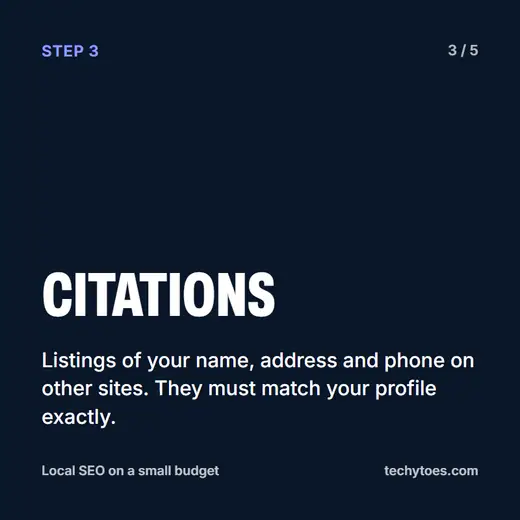
A citation is any listing of your business name, address and phone number on another website. Google uses them to confirm you’re a real business at the place you say you are.
Start with the ones that matter most, all of them free: Apple Business Connect, Bing Places, Yelp, Facebook, the Better Business Bureau and one or two directories for your industry. The rule that matters is consistency. Use exactly the same name, address and phone number everywhere, written the same way, matching your Google Business Profile. Our list of Tampa Bay local citations covers the regional ones too.
4. Content and backlinks
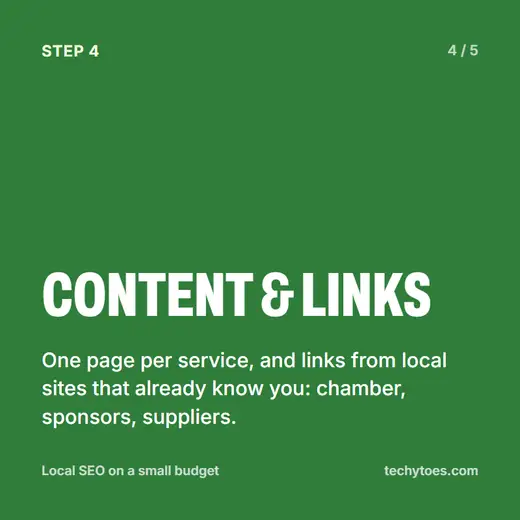
Content. Your website needs one page for each main service, written in plain language and mentioning the areas you serve. A single “Services” page that lists everything rarely ranks for any of it. Answer the questions customers ask you on the phone. Those answers make good pages, and they’re things you already know.
Backlinks. A link from another website to yours tells Google someone vouches for you. For a small local business, the best links are local and earned through things you already do: your chamber of commerce membership, a local sponsorship, a supplier or partner who lists you, a community event, or a local news story. Skip anyone selling links in bulk. Those links tend to be low quality and can do more harm than good.
5. Social media profiles
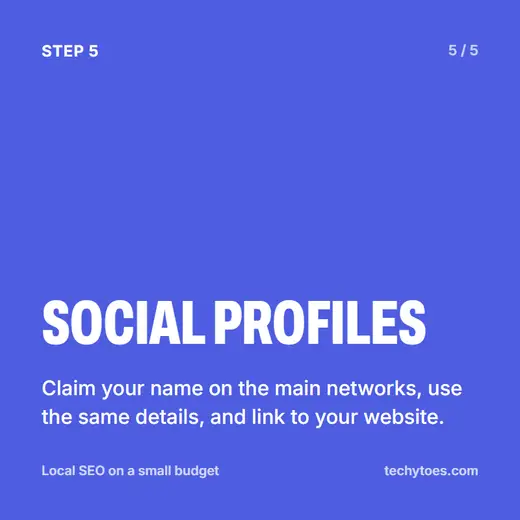
Claim your business name on Facebook, Instagram, LinkedIn and anything else your customers use, even if you don’t post much yet. Use the same name, address, phone number and website as everywhere else, and link back to your site. Social profiles don’t move your Google rankings much on their own, but they’re often what people check before calling, and they keep your details consistent. Post when you have something real: a finished job, a review, a tip.
Local SEO on a small budget: five terms
When it’s worth paying for help
You can do all five steps yourself. Paying someone makes sense when your time is worth more on the tools than at the keyboard, or when you’ve done the basics and stopped moving. Our local SEO services start at $300 a month and cover the profile, reviews workflow, citations and pages together. If you’re in Pinellas County, see how this works on our St. Petersburg FL SEO page.
Key takeaways
- Start with the free steps. Google Business Profile and reviews cost nothing but time.
- Consistency beats volume. The same name, address and phone everywhere matters more than dozens of listings.
- You don’t need hundreds of reviews. In our study, 31 of 120 top-3 spots went to listings with fewer than 50.
- One page per service. It gives Google something specific to rank.
- Earn links locally. The best ones come from things you already do.
Quiz: test what you learned
Five questions on this guide. Tap a question to see the answer.
1. What's the most valuable free SEO step for a new local business?
Setting up and verifying a Google Business Profile, with the right primary category and every field filled in.
2. How many service areas can you list on a Google Business Profile?
Up to 20, and Google recommends keeping them within about two hours' drive of your base.
3. What's the one rule that matters most for citations?
Consistency: the same business name, address and phone number everywhere, matching your Google Business Profile.
4. In our St. Petersburg study, how many of the 120 top-3 spots went to listings with fewer than 50 reviews?
31 of the 120.
5. Where do the best backlinks for a small local business come from?
Local sources you already have a connection with: your chamber of commerce, sponsorships, suppliers and partners, community events and local news.