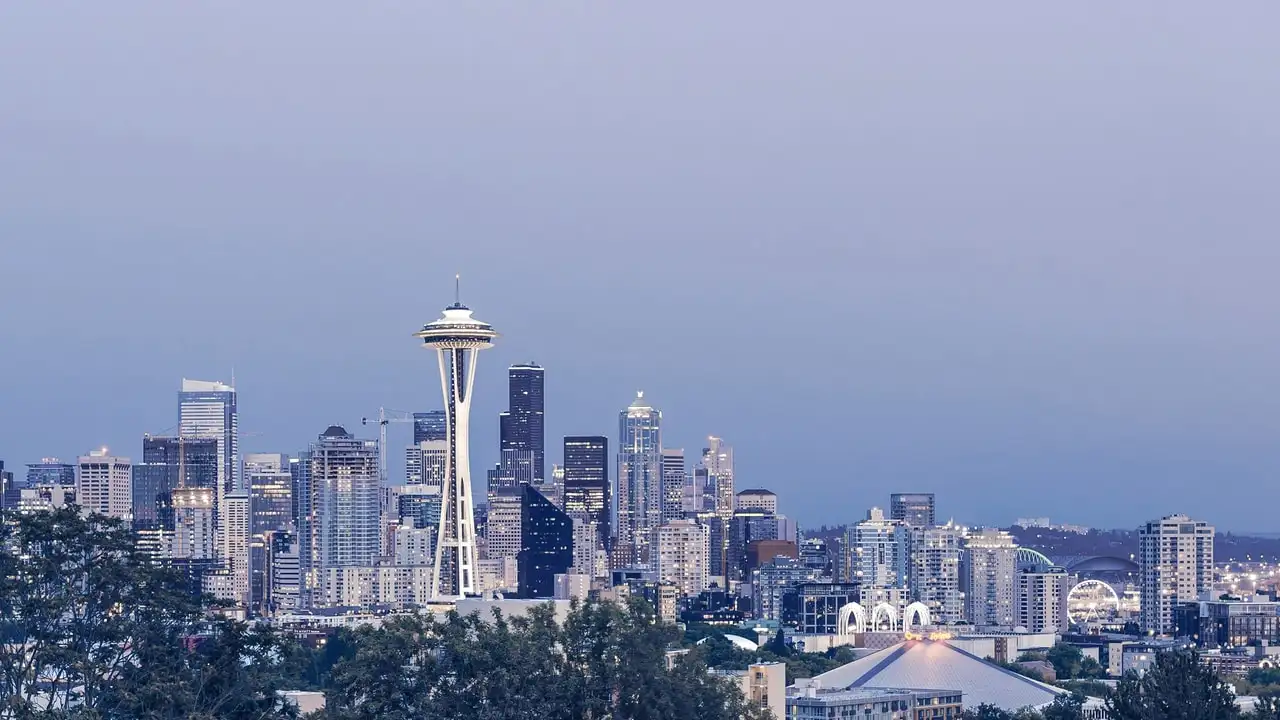
Washington redesigns run $8,500–$34,000. Rendering architecture changes sit at the upper end, and we would generally recommend scheduling the whole project through the winter regardless of what it costs to wait.
Why this looks different in Washington
A Washington redesign is usually the right moment to fix a rendering problem, because this market builds client-rendered sites by default and its buyers adopted AI-assisted research earlier than almost anyone. Content that Google eventually renders but AI systems never see is a genuine commercial gap here, and moving content pages to server rendering is an architectural change a rebuild can absorb.
The preservation priority is the Eastside branch. Bellevue, Kirkland and Redmond are searched as a distinct market that a Seattle listing cannot reach, so any pages covering them are the only coverage of an affluent, commercially dense region — and they are exactly what gets folded into a Seattle service-area section during a tidy-up.
Washington specifics
What actually gets in the way here
These are conditions particular to this market. If they were true everywhere, they would not be worth a page.
01
Rebuilds that carry the rendering problem forward
Washington defaults to client-rendered builds while its buyers use AI research earliest. Rebuilding on the same architecture preserves the market's most consequential technical gap.
02
Eastside coverage folded into Seattle
Bellevue, Kirkland and Redmond are a separate market a Seattle listing cannot reach. Consolidating those pages during a rebuild removes coverage of the most commercially dense part of the region.
03
Seasonal pages cut on a recent-quarter view
Summer service pages earn almost nothing for most of the year and carry a compressed season of demand. A rebuild judged on ninety days of data removes them, and rebuilding in June is too late.
Our approach
How we run website redesign in Washington
The same four stages we run everywhere, applied to this market's conditions. The sequence matters more than any individual tactic.
01
Establish what must survive
Search Console export, full crawl, backlink review and conversion path analysis produce the protected list: URLs that must redirect one-to-one, content that ranks and cannot be cut, and the pages carrying the majority of commercial value.
02
Structure and design against that constraint
New page inventory and URL map built to accommodate the protected list, resolving the cannibalisation and orphan problems the old structure accumulated. Then design, focused on the templates that actually earn.
03
Build with the redirect map in place
Development against performance and accessibility targets, with the redirect map written and tested during the build rather than after. Staging is checked for noindex and canonical directives that must not reach production.
04
Launch and watch closely
Launch-day verification of redirects, robots directives, canonicals and sitemaps, then weekly indexation and ranking monitoring for a month. Anything that moves the wrong way gets diagnosed while it is still cheap.
Local tip
Do the rebuild in winter, not spring. A launch problem in April costs you the entire Washington summer, and for outdoor-adjacent categories that is most of the year — whereas the same problem in December has months of slack to absorb it.
How we would measure it
Measured on server-rendered content verified per template, indexation and rankings reported separately for Seattle and Eastside branches, and seasonal pages checked against the same period a year prior rather than the preceding month.
Proof
What we can stand behind
One documented client result, plus the market data explaining the conditions website redesign operates in. Each figure is labelled with what it is.
84% organic traffic increase in 3 months Documented client result
of Google queries now return an AI Overview
40%+ of Google queries now return an AI Overview HubSpot, 2026
fewer businesses shown in AI-generated local packs than classic map results
68% fewer businesses shown in AI-generated local packs than classic map results Industry research, 2026
of "near me" searchers visit a business within 24 hours
76% of "near me" searchers visit a business within 24 hours Shopify Local SEO Statistics, 2026
better conversion from fully optimised Google Business Profiles
1.8x better conversion from fully optimised Google Business Profiles Whitespark, 2026
The 84% figure is a documented result for a single client, not a projection of typical performance in this market. The figures beneath it are published market statistics from the sources named, included because they explain the environment rather than because they are our results.
Nearby markets
Website Redesign in markets adjacent to Washington
Adjacent markets are not interchangeable — each of these pages is written around that market's own competitive conditions.
Should a Washington rebuild change how the site renders?
Usually yes, and a redesign is the only realistic moment to do it without a separate engineering project. Washington sites are disproportionately client-rendered JavaScript applications because the region's engineering culture propagates across every category, and this market has the earliest-adopting audience we work with — buyers who were using generative assistants for research well before the general population, on systems that frequently do not execute JavaScript at all. So a Washington business can rank conventionally while being entirely absent from the surface its buyers consult. The change is scoped: content pages server-rendered or statically generated, interactive areas left client-side where that genuinely helps. We make it an explicit acceptance criterion and verify it by fetching pages with JavaScript disabled, because framework configuration frequently does not do what the team assumed.
Why must the Eastside branch survive the rebuild intact?
Because Lake Washington is a hard ranking boundary and those pages are the only coverage of the market on the other side of it. The bridges are genuine bottlenecks, Eastside residents search Bellevue, Kirkland or Redmond specifically, and a Seattle-registered Google Business Profile will not hold position there for competitive consumer categories — so there is no profile-side compensation if the organic pages disappear. Given that the Eastside is affluent and commercially dense with a substantial technology and professional services base, folding those pages into a Seattle service-area section during a tidy-up removes coverage of one of the most valuable markets in the region. The preservation audit should report Seattle and Eastside separately for exactly this reason, so their individual performance is visible before consolidation is proposed.
How do we stop seasonal pages being cut from a Washington rebuild?
By auditing a full year rather than a recent quarter, because Washington's pattern is extreme enough to make ninety days actively misleading. The long winter suppresses outdoor-adjacent demand for months, and then a short summer produces sharp spikes in landscaping, roofing, home improvement and recreation — so a preservation audit run in February on ninety days of data will show those pages earning almost nothing and mark them as removable. Then June arrives, the pages are gone, and rebuilding them means ranking after the window has closed, because the season is shorter than the indexing cycle. Pull twelve months, protect the seasonal pages explicitly, and design a template for them that fits the new system rather than removing them and intending to rebuild later.
Should a Washington redesign be phased or relaunched at once?
Phased, if the site earns meaningful organic traffic, and there is a Washington-specific reason beyond the usual risk argument: the seasonal window. A single relaunch that goes wrong in April costs you the entire summer, because diagnosis and recovery take longer than the season lasts — and for outdoor-adjacent categories that is most of the year's revenue. Phasing template by template isolates the risk and lets you verify against real data before continuing. The timing recommendation follows from the same logic: do the rebuild through the winter, when a problem costs comparatively little and there is time to correct it, rather than in spring when the pressure to launch collides with the season that matters. That is frequently the opposite of when businesses want to do it.
Coverage area
Serving Washington and Surrounding Neighborhoods
Our team works from St. Petersburg, FL, and covers
Washington alongside the surrounding communities below.
Neighborhoods and communities we cover
Downtown Seattle
Capitol Hill
Ballard
Fremont
Downtown Bellevue
Tacoma Waterfront
Zip codes served
98101
99201
98402
98004
Find out what your current site earns before you change it in Washington
We will audit which URLs actually generate your traffic and enquiries, and send you the protected list. Whether you redesign with us or not, do not start without that document.