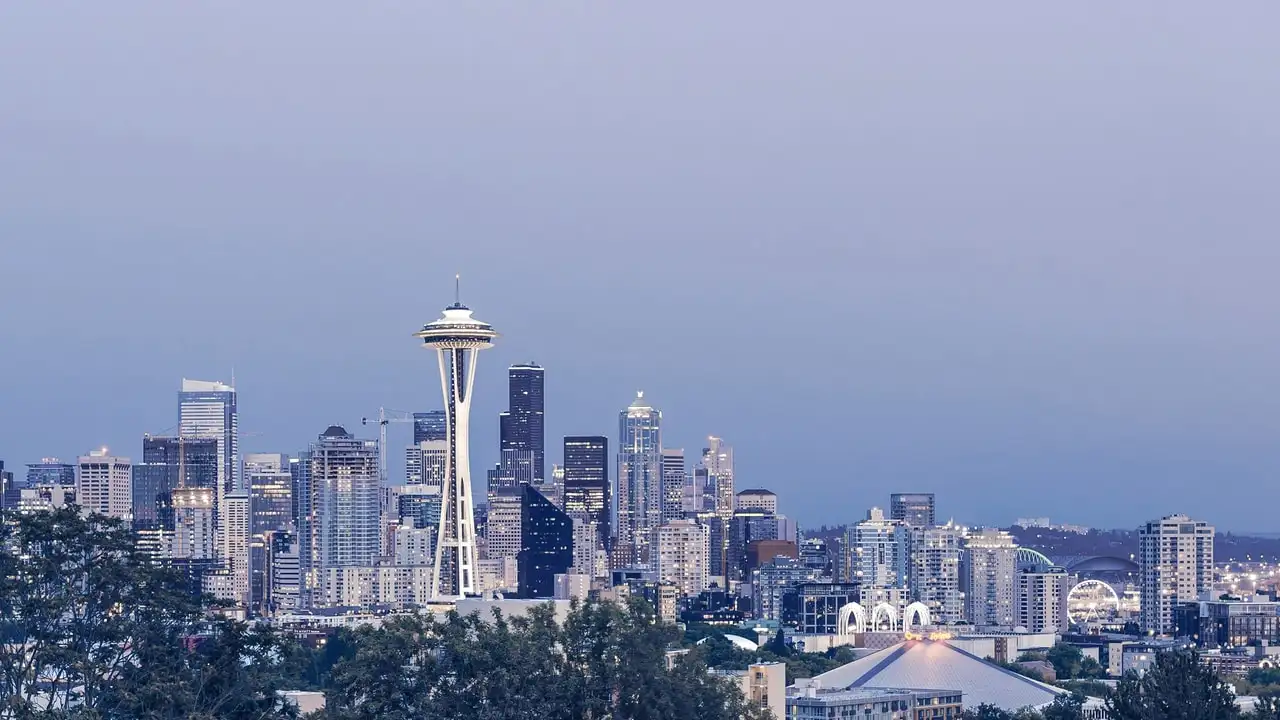
Washington social management runs $900–$2,800 per month, and we typically scope it as an uneven annual cadence rather than a flat monthly figure, because the production year genuinely is uneven here.
Why this looks different in Washington
Washington social planning is dominated by an unusually uneven year. The long grey winter suppresses outdoor activity and the visual material that goes with it for months, then a short reliable summer produces a compressed period where the same business has far more to show and far more demand to meet. Planning a flat annual cadence means producing the wrong content for most of the year and having nothing to produce for part of it.
The second factor is audience segmentation across a hard geographic boundary. Seattle and the Eastside are distinct communities — locals treat the lake as a real divide — and content addressed to one does not read as belonging to the other. Across the Cascades, Eastern Washington is a different market again, with conventional local networks where consistent presence is achievable in a way it is not in Seattle.
Washington specifics
What actually gets in the way here
These are conditions particular to this market. If they were true everywhere, they would not be worth a page.
01
A winter with nothing to produce and a summer with no time to produce
Outdoor and visual material disappears for months, then returns during the busiest operational period. Accounts that planned flat cadences go quiet in January and again in July, for opposite reasons.
02
Seattle and Eastside audiences treated as one
Locals treat Lake Washington as a genuine divide, and Eastside communities have their own identity and networks. Seattle-addressed content does not read as belonging on the other side of the bridge.
03
Technology-sector accounts running local playbooks
Seattle and Eastside software companies competing nationally gain nothing from community content, yet frequently run it because it is the default deliverable while their actual buyers are elsewhere entirely.
Our approach
How we run social media management in Washington
The same four stages we run everywhere, applied to this market's conditions. The sequence matters more than any individual tactic.
01
Audit and platform decision
We review your existing accounts, your competitors' actual performance rather than their follower counts, and where your category's buying conversations happen. The output includes an explicit recommendation on which platforms to stop using.
02
Define the account's job and its pillars
We agree whether this account exists for discovery, consideration or retention, then build the content pillars that serve that job. Skipping this step is why most accounts produce content that is competent and pointless.
03
Build a content bank, then start publishing
We produce four to six weeks of content before the first post goes out. Launching with a buffer is the single strongest predictor of whether a social programme survives its first busy month.
04
Publish, engage, and iterate on evidence
Consistent publishing with active community management, reviewed monthly against outcome metrics. Pillars that consistently underperform get replaced rather than defended, which requires reporting honest enough to show it.
Local tip
Shoot your summer content in surplus during the two or three good months and bank it. Washington businesses in outdoor-adjacent categories consistently underestimate how little usable visual material the winter produces, and the accounts that stay consistent are the ones that over-produced in July.
How we would measure it
Reported separately for Seattle, the Eastside and any Eastern Washington coverage, with seasonal periods compared year over year rather than month to month, since a month-on-month comparison here is dominated by the season.
Proof
What we can stand behind
One documented client result, plus the market data explaining the conditions social media management operates in. Each figure is labelled with what it is.
84% organic traffic increase in 3 months Documented client result
of Google queries now return an AI Overview
40%+ of Google queries now return an AI Overview HubSpot, 2026
fewer businesses shown in AI-generated local packs than classic map results
68% fewer businesses shown in AI-generated local packs than classic map results Industry research, 2026
of "near me" searchers visit a business within 24 hours
76% of "near me" searchers visit a business within 24 hours Shopify Local SEO Statistics, 2026
better conversion from fully optimised Google Business Profiles
1.8x better conversion from fully optimised Google Business Profiles Whitespark, 2026
The 84% figure is a documented result for a single client, not a projection of typical performance in this market. The figures beneath it are published market statistics from the sources named, included because they explain the environment rather than because they are our results.
Nearby markets
Social Media Management in markets adjacent to Washington
Adjacent markets are not interchangeable — each of these pages is written around that market's own competitive conditions.
How do we plan a content year around Washington seasonality?
Deliberately unevenly, with two production pushes rather than a flat cadence. The pattern is a long winter that suppresses outdoor activity and the visual material that accompanies it, followed by a short reliable summer that is simultaneously the busiest operational period — so accounts planned at a uniform three posts a week go quiet in January because there is nothing to shoot, and again in July because there is no time to shoot it. What works is producing summer content during the summer at higher volume than you publish, banking the surplus, and using the winter to publish that bank alongside formats that do not depend on outdoor material. It also means the winter is the right time to prepare for the following summer, since the window is too short to build during and too busy to produce in.
Do Seattle and the Eastside need separate content?
They need content that reads as belonging to each, which may or may not mean separate accounts depending on your capacity. Locals genuinely treat Lake Washington as a divide — the bridges are real bottlenecks and the Eastside has its own centre of gravity, its own communities and its own local networks — so Seattle-addressed content does not land as belonging in Bellevue or Kirkland, and vice versa. Where you have genuine presence and activity on both sides and the capacity to sustain two accounts, separate accounts perform better. Where you do not, the workable version is content that explicitly references and is anchored to each side at different times on one account, which captures some of the relevance without the production burden. A dormant second account is worse than a single well-maintained one.
Should a Seattle technology company run local social content?
No, if it sells nationally, and this is one of the more common wasted budgets in this market. A Seattle or Eastside software company selling to geographically unconstrained buyers gains nothing from community content, local anchoring or neighbourhood presence — its buyers are not in Washington and are not evaluating it on local visibility. What works for that audience is substantive expertise content on LinkedIn and any category-specific community where technical buyers actually gather, at a standard that would withstand scrutiny from somebody who knows the field. This audience is also the earliest adopter of AI-assisted research we work with, which means written substance that can be retrieved and cited travels further than production polish. Diagnosing which side of this line you are on is the first conversation and frequently the entire one.
Is Eastern Washington worth separate social investment?
For businesses that genuinely serve it, yes, and it is comparatively cheap to establish presence there. Spokane and the surrounding Eastern Washington markets have conventional local ecosystems — active community networks, local media, and enough available attention that consistent competent content can make a business a recognised presence. That is achievable there in a way it is not in Seattle, where attention is far more contested. The competition for local attention is also thin because agency and marketing attention concentrates entirely on Puget Sound. The constraint is the same as everywhere: only run an account you can sustain, and content anchored to a market where you have no genuine activity to show reads as hollow. Where capacity is limited, Eastern Washington content on a main account is a reasonable middle position.
Coverage area
Serving Washington and Surrounding Neighborhoods
Our team works from St. Petersburg, FL, and covers
Washington alongside the surrounding communities below.
Neighborhoods and communities we cover
Downtown Seattle
Capitol Hill
Ballard
Fremont
Downtown Bellevue
Tacoma Waterfront
Zip codes served
98101
99201
98402
98004
Get a straight answer on which platforms are worth your time in Washington
We will audit your accounts and your competitors' real performance, and tell you which platforms to invest in and which to walk away from. The recommendation to drop something is usually the valuable part.